 Repostit Team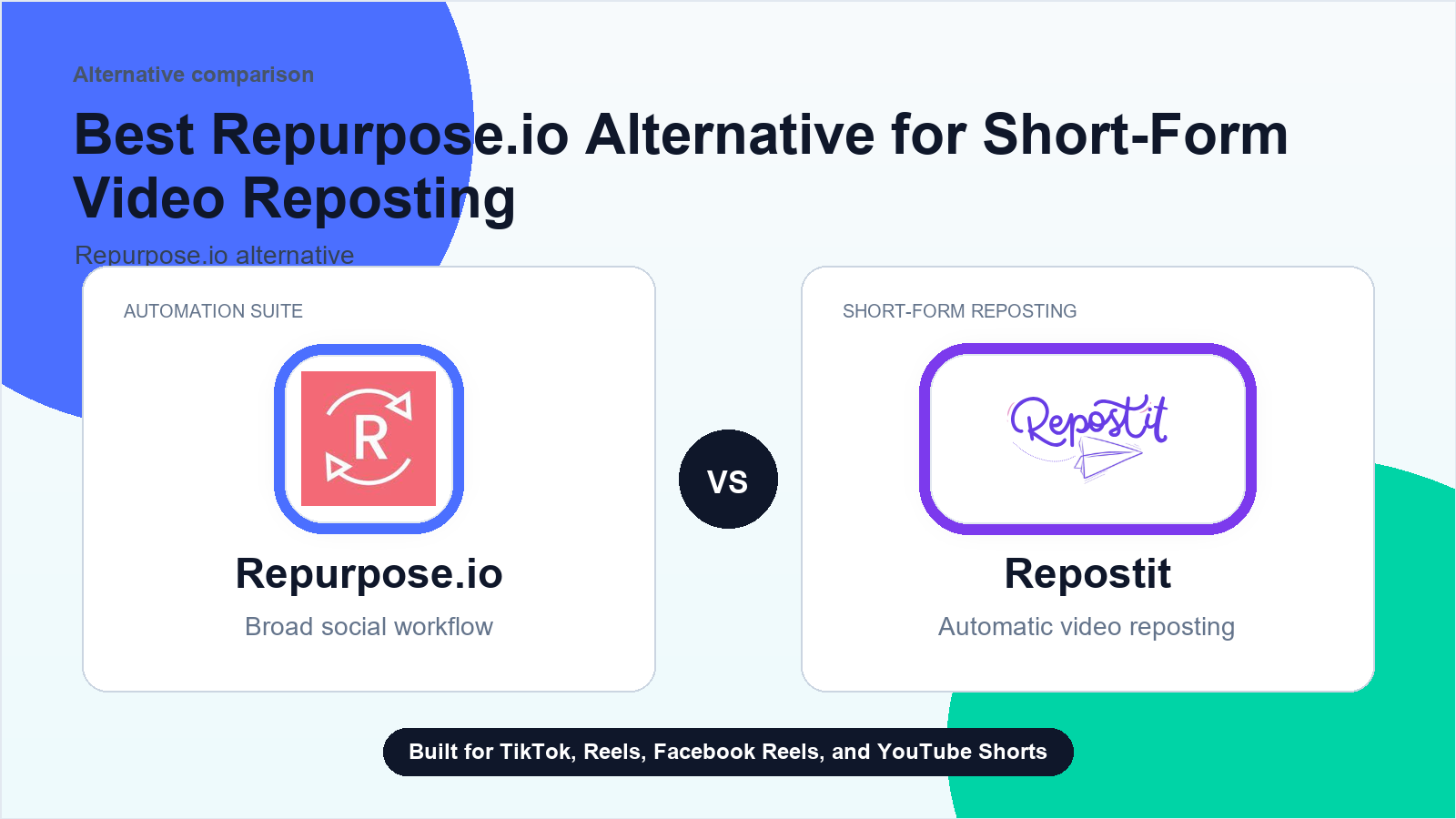
Start with the workflow, not the frustration
Burned-in captions are part of the finished video, not just the social caption field. The buyer may need open captions for silent viewing, subtitles from an SRT file, a captioned export for accessibility, or a rendered file that looks right after cropping and resizing. Before switching tools, decide whether the real bottleneck is automatic transcription, subtitle editing, caption-file matching, style and safe-zone review, or simply distributing the already-approved captioned video.
This page is written for buyer-intent research, not for venting about a competitor. The practical question is simple: which part of the short-form distribution workflow must keep working every week, and which parts are optional? If the essential job is moving finished short videos to TikTok, Instagram Reels, Facebook Reels, and YouTube Shorts, a focused Repostit test can be cleaner than rebuilding a broad content stack.
First checks before you switch
- Decide whether the destination needs burned-in open captions, platform-native captions, an uploaded SRT file, or only a written post caption.
- Confirm who creates the transcript: YouTube or Facebook captions, a manual SRT export, Descript, another editor, or a platform-native caption tool.
- Keep the video file, SRT or VTT file, language, filename, duration, and version number together so the wrong captions cannot be matched to the wrong asset.
- Review line length, timing, spelling, speaker labels, emojis, brand terms, URLs, and disclosure wording before the captions are rendered.
- Check crop and safe zones after the captioned video is resized for TikTok, Instagram Reels, Facebook Reels, or YouTube Shorts.
- Test one owned captioned video end to end and save the source file, caption file, rendered preview, destination URL, account label, and cleanup notes.
- Do not rely on the distribution step to fix transcript mistakes, caption styling, accessibility requirements, or a caption file that was attached to the wrong video.
- Compare tools by caption-file handling, rendered preview, revision control, destination support, failure visibility, and the time saved after the final captioned file is approved.
Write down the result of each check. If the issue is a disconnected destination, switching tools will not fix the account permission. If the issue is that the workflow has become too broad or hard to trust, then a smaller source-to-destination workflow is worth testing.
Where Repostit fits
Repostit is worth testing only after the video already has approved burned-in captions or the required subtitle file is handled elsewhere. It is not a caption burner, subtitle editor, transcript editor, SRT or VTT manager, caption-style tool, accessibility compliance system, speech-to-text engine, video editor, or workaround for platform-native caption controls.
Repostit is not positioned as a full replacement for every repurposing job. It is strongest when the clip already exists and the team needs reliable distribution without repeating the upload loop. The best comparison page for that decision is the Repurpose.io alternative guide.
Keep broad tools for broad jobs
Podcast clips, livestream workflows, approval systems, analytics suites, and broad content operations may still belong in a larger platform.
Use Repostit for repeated uploads
If the repeated work is sending finished shorts to the right destinations, start with one Repostit rule and verify the first posts.
Measure before migrating
Do not switch everything at once. Track posts moved, failures, manual minutes saved, and whether each destination created extra reach.
Use the adjacent caption checks too
Burned-in captions are not the same as AI caption writing, reusable caption templates, TikTok line breaks, platform-native caption fields, or Descript transcript handoff. Use the caption-control checklist when the issue is generated post copy, the caption-template checklist when reusable written captions are the bottleneck, the TikTok line-break checklist when spacing breaks in the public caption field, and the Descript transcription and media checklist when transcript edits or caption-file export own the workflow before distribution.
A safe one-week test
- Choose one source account that publishes consistently.
- Choose one destination where reposting creates real value.
- Connect the accounts and create the narrowest useful Repostit workflow.
- Review every repost for the first week instead of turning on every possible rule.
- Compare manual upload time with the automated workflow and decide whether to add another destination.
For broader background on the category, use the automatic video reposting tool guide and the Reels and Shorts crossposting guide. If the source channel is YouTube Shorts, the most relevant workflow is YouTube Shorts to TikTok and Instagram Reels.
What not to do
- Do not buy a new platform before documenting the workflows you actually use.
- Do not assume every failed post is caused by the same layer of the stack.
- Do not automate videos that you do not own or have rights to use.
- Do not copy platform-specific captions blindly across every destination.
- Do not treat crossposting as a growth guarantee; each platform still needs review and measurement.
Decision rule
Keep the existing platform if it is still earning its place through broad repurposing, reporting, approvals, or multi-format workflows. Add or switch to Repostit when the daily pain is narrower: the team already has finished short videos, but manual distribution keeps slipping. That is the workflow Repostit is built to own.
The goal is not to post everywhere blindly. The goal is to make the repeatable distribution layer dependable enough that creators can spend more time improving the clip, hook, and offer. Start with one workflow, inspect the first results, then expand only when the evidence says the automation is doing useful work.
Related guides
- Auto Crosspost Reels and Shorts Across Every Platform
- Automatic Video Reposting Tool for TikTok Reels and Shorts
- Best Buffer Alternative for Automatic Short-Form Crossposting
- Best ContentStudio Alternative for Short-Form Video Crossposting
- Best Hootsuite Alternative for Short-Form Video Crossposting
FAQ
What should I check first for this burned-in captions, subtitles, or caption-file export concern?
Start with account connections, destination permissions, source filters, platform rules, video format, and a single fresh test post. Do not change every workflow before isolating the cause.
Is Repostit a replacement for every Repurpose.io workflow?
No. Repostit is focused on short-form reposting. Keep a broader repurposing platform when you need podcast, livestream, approval, analytics, or wide content-operations features.
When is Repostit worth testing?
Repostit is worth testing only after the video already has approved burned-in captions or the required subtitle file is handled elsewhere. It is not a caption burner, subtitle editor, transcript editor, SRT or VTT manager, caption-style tool, accessibility compliance system, speech-to-text engine, video editor, or workaround for platform-native caption controls.
How should I run the first test?
Use one source account, one destination, and a week of review. Track whether the post moved, whether the caption and asset looked right, and whether the destination created extra reach.
Should I cancel a current tool before testing Repostit?
No. Run a narrow Repostit test first, document active workflows, and switch only after the repeated short-form upload layer is working reliably.
Try the narrow workflow first
If short-form reposting is the bottleneck, test Repostit with one source, one destination, and a week of review before changing the rest of your stack.