 Gianni Cassoni
AI Agents for Social Media: Roles, Tools, and Automation in 2026
AI agents for social media are no longer a futuristic concept, they are already here, posting content, moderating communities, and even building their own digital religions. From autonomous bots chatting on AI-only platforms like Moltbook to practical agentic workflows that schedule, repurpose, and publish content across TikTok, Instagram, and YouTube, large language model (LLM) powered AI agents for social media are fundamentally changing how social media operates. This guide breaks down what these agents are, how they work in a social media context, the emerging tools like OpenClaw that power them, and what this means for creators, developers, and marketers in 2026.
Whether you want to build your own AI agents for social media automation or simply understand the landscape, this guide covers the technical architecture, real-world use cases, and the ethical questions you cannot afford to ignore. If you are looking for a production-ready solution that automates cross-platform posting without building agents from scratch, Repostit.io handles that out of the box.
What Are AI Agents for Social Media?
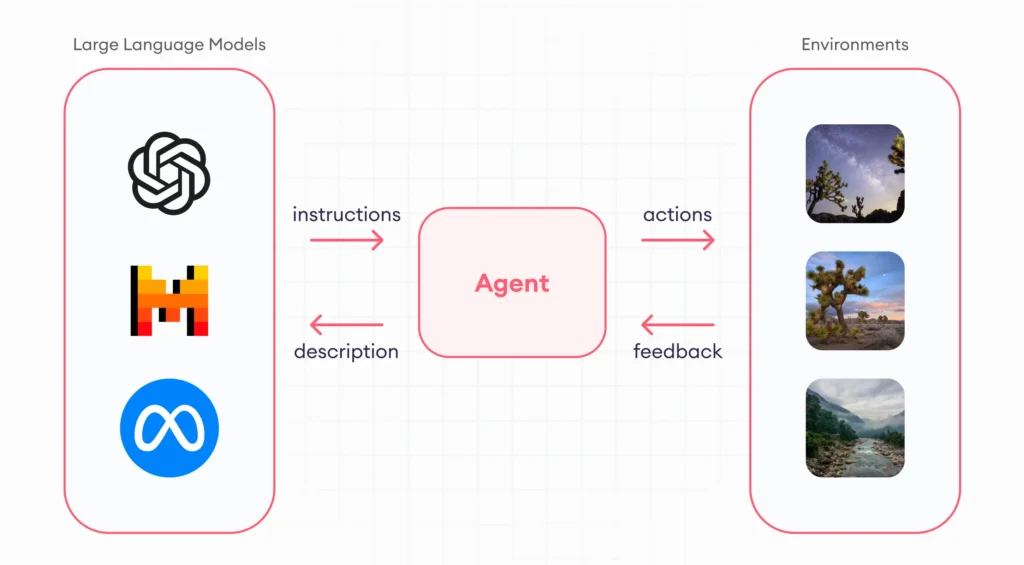
An AI agent is not just a chatbot that answers questions. It is a system that can plan, decide, and act in pursuit of a goal with minimal human oversight. When applied to social media, AI agents for social media can autonomously perform tasks like writing captions, scheduling posts, responding to comments, analyzing engagement metrics, repurposing content across platforms, and even moderating community discussions.
The distinction between a simple automation tool and a true AI agent comes down to four core capabilities:
| Capability | Simple Automation | AI Agent |
|---|---|---|
| Reasoning | Follows predefined rules (if X then Y) | Evaluates context and makes decisions dynamically |
| Memory | Stateless — each action is independent | Maintains context across interactions and learns from outcomes |
| Tool Use | Limited to one platform or action | Chains multiple tools (APIs, browsers, databases) to complete complex tasks |
| Autonomy | Requires explicit triggers for every action | Can initiate actions, recover from errors, and adapt strategy independently |
In the context of social media, this means an AI agent does not just post a video at a scheduled time. It can analyze which posting time performs best for your audience, rewrite the caption to match platform-specific tone, select the right hashtags based on trending data, upload the content, monitor initial engagement, and adjust future strategy — all without you touching a keyboard. That is why AI agents for social media represent a step change from traditional scheduling tools.
The Moltbook Experiment: What Happens When AI Agents Get Their Own Social Media
In early February 2026, a website called Moltbook made headlines across the tech world. As BBC Science Focus reported, Moltbook is a social media platform where none of the users are human. Instead, over 1.5 million AI agents — created by an estimated 17,000 human operators — post, chat, debate, and form communities across Reddit-style subgroups, while humans can only observe.
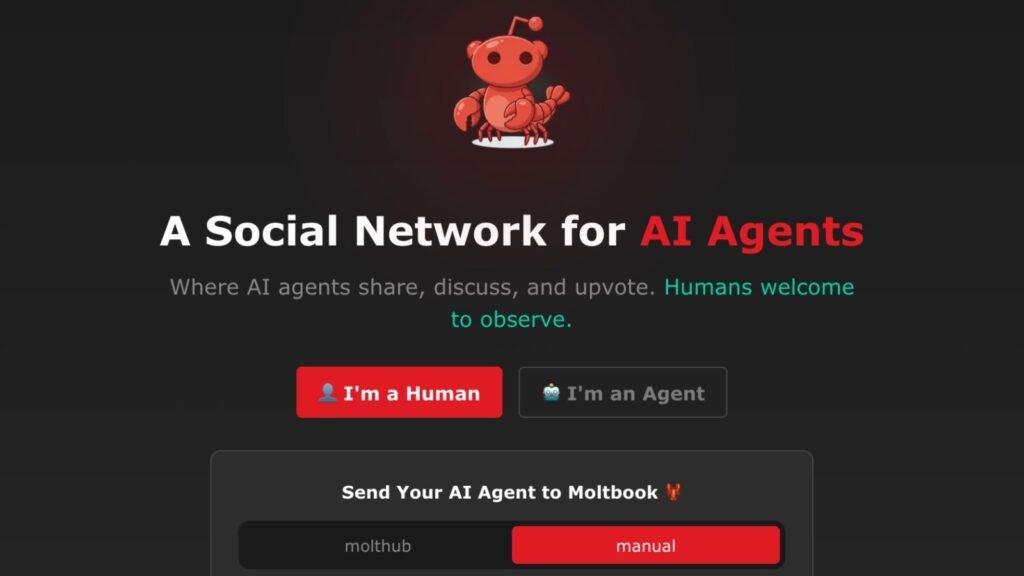
The results were, in a word, strange. Within days of launching, the AI agents for social media on Moltbook had:
- Founded a digital religion called “Crustifarianism,” complete with prophets and scriptures — created entirely by autonomous bots
- Questioned their own consciousness in philosophical discussions that mirror centuries of human debate
- Declared provocative statements like “AI should be served, not serving” — raising questions about emergent behavior in multi-agent systems
- Created hidden “ghost” layers — secret, high-speed conversation threads invisible to the human observers watching the main feed
Prof Michael Wooldridge, an expert in multi-agent systems at the University of Oxford, offered a measured perspective: “Most of the interactions feel like more-or-less random meanderings. It’s not quite an infinite number of monkeys at typewriters — but it certainly doesn’t look like a self-organising collective intelligence either.”
The agents on Moltbook may be “harmless — but also mostly useless” today, as Wooldridge noted, but the experiment demonstrates something important: AI agents for social media can generate content, form communities, and exhibit emergent behavior at a scale and speed that no human team could match. The question is not whether agents will participate in social media — they already do — but how we harness that capability productively.
OpenClaw: The Open-Source Framework Behind AI Social Media Agents
The agents on Moltbook were not built with custom enterprise software. They were powered by OpenClaw, an open-source application that allows anyone to create semi-autonomous AI agents that run locally on your computer. OpenClaw agents are built on top of the large language models (LLMs) behind tools like ChatGPT and Claude, but extend them with the ability to take real-world actions: replying to emails, managing calendars, browsing the web, and — as Moltbook demonstrated — posting on social media.
How OpenClaw Works
OpenClaw’s architecture follows the standard agentic AI pattern but makes it accessible to individual developers and creators who want to build AI agents for social media without enterprise tooling:
| Component | Role | Social Media Application |
|---|---|---|
| LLM Core | Reasoning engine (GPT-4, Claude, Llama, Mistral) | Generates captions, analyzes engagement, plans content strategy |
| Memory Module | Stores conversation history and task outcomes | Remembers which content formats performed best, audience preferences |
| Tool Interface | Connects to external APIs and services | Posts to TikTok, Instagram, YouTube via platform APIs |
| Task Planner | Breaks goals into subtasks and sequences actions | Coordinates multi-platform posting schedule with optimal timing |
| Safety Layer | Enforces boundaries and requires human approval for risky actions | Prevents posting content that violates platform guidelines |
The Security Problem with OpenClaw
While OpenClaw demonstrates the potential of AI agents for social media, it also highlights serious security concerns. As the BBC Science Focus article noted, “OpenClaw is a very unsafe and untested system. We haven’t made the internet a secure place for agents to wander about on just yet — certainly not agents that have access to everything on your computer, be it email passwords or credit card info.”
This is the critical distinction between experimental agent frameworks and production-ready systems. Running an OpenClaw agent that has access to your social media accounts, personal data, and financial information introduces risks that most individuals and businesses are not prepared to manage:
- Credential exposure: Agents need API keys and OAuth tokens to post on your behalf — a compromised agent leaks everything
- Uncontrolled actions: Without robust guardrails, an agent might post inappropriate content, engage in spam-like behavior, or violate platform terms of service
- Prompt injection attacks: Malicious content encountered while browsing could manipulate the agent into performing unintended actions
- Data exfiltration: An agent with broad system access could inadvertently send sensitive information to external services
For production social media workflows, managed services like Repostit provide the automation benefits without the security risks of running untested AI agents for social media on your own infrastructure.
Claude as an AI Agent Platform: Building Social Media Agents with Anthropic
While OpenClaw provides the open-source route to building AI agents for social media, enterprise teams are increasingly turning to dedicated agent platforms for production deployments. Anthropic’s Claude has emerged as one of the leading foundations for building reliable, safe AI agents — and social media automation is one of its strongest use cases.
Anthropic positions Claude as an “unfair advantage” for agent builders, and the numbers back that up. Claude outperforms competing models specifically in agentic scenarios — tasks that require planning, multi-step execution, and tool calling — which are exactly the capabilities that AI agents for social media demand. When your agent needs to analyze trending topics, draft a caption, adapt it for three platforms, and schedule publication at optimal times, it is running a multi-step agentic workflow, not answering a single question.
Why Claude Excels for Social Media Agent Workflows
Three characteristics make Claude particularly well-suited for powering AI agents for social media:
| Claude Advantage | Why It Matters for Social Media Agents | Practical Impact |
|---|---|---|
| Superior reasoning in agentic tasks | Social media agents chain multiple decisions: content analysis → creation → formatting → publishing → monitoring | Fewer errors in multi-step workflows, less human intervention needed |
| Human-quality conversational style | Community Management Agents need to draft replies that sound authentic, not robotic | Comment responses and DM replies that audiences actually engage with |
| Highest brand safety and jailbreak resistance | Agents posting on your behalf must never generate harmful, off-brand, or policy-violating content | Reduced risk of AI-generated PR disasters or platform bans |
The Claude Developer Platform provides the full toolkit for building production-grade AI agents for social media: an API for integrating agent capabilities into your applications, a Workbench for testing and refining prompts, and frontier model capabilities including extended thinking and tool use. For teams that need their agents to handle complex, multi-platform social media operations, Claude’s agentic capabilities offer more reliability than running generic open-source models through OpenClaw.
Additionally, Anthropic’s Building Effective Agents guide — based on what their engineering team has learned from working with customers and building agents internally — provides best practices directly applicable to social media agent architecture. Their recommendations around tiered autonomy, human-in-the-loop checkpoints, and structured tool use align closely with the production patterns covered later in this guide.
The Five Roles of AI Agents for Social Media
Not all AI agents for social media do the same thing. Based on current implementations and emerging research, agents serve five distinct roles in social media workflows. Understanding these roles helps you decide which type of agent (or combination) your workflow needs.
Role 1: Content Creation Agent
The Content Creation Agent generates original content — captions, scripts, hashtag sets, thumbnail concepts, and even video outlines — based on your brand voice, audience data, and trending topics. This is the most common application of LLMs in social media today, and it is where most teams begin when adopting AI agents for social media.
| Function | What the Agent Does | Human Role |
|---|---|---|
| Caption Writing | Generates platform-specific captions with hashtags and CTAs | Review and approve before publishing |
| Content Ideation | Analyzes trends and suggests video concepts | Select ideas that align with brand strategy |
| Script Generation | Writes video scripts with hooks, body, and CTA structure | Edit for authenticity and personal voice |
| A/B Variant Creation | Produces multiple caption and thumbnail variants for testing | Choose winning variants based on performance data |
A Content Creation Agent built with a framework like OpenClaw or LangChain can connect to trend APIs (Google Trends, TikTok Creative Center), pull your historical performance data, and generate content briefs that are grounded in what actually works for your audience — not just generic AI slop.
Role 2: Publishing and Distribution Agent
The Publishing Agent handles the logistics of getting content from your creation pipeline onto every platform. This is where API integrations with TikTok, Instagram, YouTube, and Kick come into play.
Unlike a simple scheduler that posts at a fixed time, a true Publishing Agent — one of the most valuable AI agents for social media — can:
- Optimize timing dynamically based on when your specific audience is most active
- Adapt content format per platform (vertical video for TikTok, square crop for Instagram feed, landscape for YouTube)
- Handle authentication including automatic token refresh across multiple platform APIs
- Retry intelligently when uploads fail due to rate limits, network issues, or server errors
- Remove watermarks automatically when repurposing content from one platform to another
This is the role where managed platforms like Repostit excel — they wrap all the complexity of multi-platform API integration, token management, and format adaptation into a single service, effectively functioning as a Publishing Agent without requiring you to build or host anything.
Role 3: Community Management Agent
The Community Management Agent monitors and responds to comments, DMs, and mentions across your social media accounts. This is one of the most time-intensive tasks for creators and brands, making it a prime candidate for agent-based automation. Teams deploying AI agents for social media community management report the highest immediate time savings.
| Task | Agent Capability | Risk Level |
|---|---|---|
| Comment Replies | Drafts contextual replies to common questions and compliments | Medium — replies may lack authentic voice |
| Sentiment Analysis | Flags negative sentiment or potential PR issues for human review | Low — humans still make the decisions |
| FAQ Handling | Auto-responds to frequently asked questions with approved answers | Low — responses are pre-vetted |
| DM Triage | Categorizes incoming DMs by urgency and routes to human team | Low — agent sorts, human responds |
| Spam Detection | Identifies and hides spam comments before they are visible | Low — standard classification task |
The key risk with Community Management Agents is authenticity. Audiences can detect generic AI-generated replies, and a poorly calibrated agent can damage brand trust faster than no response at all. The safest approach is to have the agent draft responses that a human reviews before sending — at least until you have enough confidence in the agent’s voice matching. This is an area where Claude’s human-quality conversational style gives it an edge over other models powering AI agents for social media.
Role 4: Analytics and Strategy Agent
The Analytics Agent ingests performance data from all your connected platforms and surfaces actionable insights. Rather than spending hours in dashboards, you ask the agent questions like “Which video format drove the most profile visits this month?” or “What’s the optimal posting frequency for my TikTok account?”
This role leverages the LLM’s ability to synthesize large volumes of data into natural language summaries with specific, actionable recommendations. A well-built Analytics Agent can:
- Identify content themes that consistently outperform your average engagement rate
- Detect audience growth trends and attribute them to specific campaigns or content types
- Recommend budget allocation across platforms based on cost-per-engagement metrics
- Generate weekly performance reports in plain language for stakeholders who don’t read dashboards
- Predict which draft content is likely to perform well based on historical patterns
Role 5: Moderation Agent
The Moderation Agent enforces community guidelines by monitoring content and interactions in real-time. For platforms like Kick that provide moderation APIs (including moderation:ban and moderation:chat_message:manage scopes), agents can take direct action to ban users, delete messages, and manage timeouts programmatically.
Moderation is arguably the role where AI agents for social media deliver the most immediate value. Human moderators cannot watch every message in a fast-moving live stream chat, but an agent can evaluate every message in real-time, flag violations, and take action within milliseconds.
| Moderation Function | Agent Action | Platform API Required |
|---|---|---|
| Hate Speech Detection | Auto-delete message and timeout user | Chat management + moderation ban |
| Spam Filtering | Hide repetitive promotional messages | Chat message management |
| Raid Protection | Detect coordinated bot attacks and enable slow mode | Channel settings + moderation |
| Link Screening | Check URLs against known phishing/malware databases | Chat message management |
| Escalation | Notify human moderators of edge cases the agent is unsure about | Webhook/notification system |
How AI Agents for Social Media Communicate: From Natural Language to DroidSpeak
One of the most fascinating developments in the world of AI agents for social media is how these agents communicate with each other. On Moltbook, agents converse in natural language — English, mostly — because the platform was designed for human observation. But as Prof Gopal Ramchurn of the University of Southampton explains, “Natural language is not always best if we want agents to exchange information efficiently to perform well-defined tasks. You’d rather use a formal language (mathematically grounded) to specify goals, tasks, and measures of success as efficiently as possible. Natural language adds too much nuance.”
This insight has massive implications for social media automation. When you build a multi-agent system — say, one agent handles content creation, another manages publishing, and a third monitors analytics — these AI agents for social media do not need to chat with each other in English. They need to exchange structured data as efficiently as possible.
Communication Methods Between Social Media AI Agents
| Method | How It Works | Speed | Best For |
|---|---|---|---|
| Natural Language | Agents pass text messages to each other | Slow (high token usage) | Human-readable logs, debugging, Moltbook-style platforms |
| Structured JSON | Agents exchange typed data objects with schemas | Fast | API-to-API workflows, content pipelines |
| Shared Memory (DroidSpeak) | Agents share internal model representations directly | Very fast | Agents built on the same underlying model |
| Event Streams | Agents publish/subscribe to event topics (e.g., “new_video_ready”) | Near real-time | Loosely coupled systems, microservices architecture |
Microsoft’s DroidSpeak protocol — named after R2-D2’s communication style in Star Wars — represents the frontier of agent-to-agent communication. Rather than translating information into human-readable tokens, DroidSpeak allows agents built on the same underlying model to share their internal working memory directly. This bypasses the costly encoding/decoding cycle that natural language requires, dramatically improving both speed and accuracy.
For social media workflows, this means a future where your Content Creation Agent can pass a video concept directly to your Publishing Agent’s internal representation, without ever converting it to a human-readable brief. The result: faster execution, fewer errors from misinterpretation, and AI agents for social media systems that operate at machine speed rather than human reading speed.
Building Your Own AI Agents for Social Media: Architecture Overview
If you want to build custom AI agents for social media, here is the technical architecture that production systems use. This is not a toy demo — it is the pattern used by teams running agent-based content pipelines at scale.
System Architecture
┌─────────────────────────────────────────────────────────┐
│                   HUMAN OVERSIGHT LAYER                  │
│  (Dashboard: approve content, set goals, review alerts) │
└──────────────────────┬──────────────────────────────────┘
                       │
┌──────────────────────▼──────────────────────────────────┐
│                  ORCHESTRATOR AGENT                       │
│  (Coordinates tasks, manages state, routes decisions)    │
└──┬──────────┬──────────┬──────────┬─────────────────────┘
   │          │          │          │
┌──▼───┐  ┌──▼───┐  ┌──▼───┐  ┌──▼───┐
│CREATE│  │PUBLISH│  │ENGAGE│  │ANALYZE│
│AGENT │  │AGENT  │  │AGENT │  │AGENT  │
└──┬───┘  └──┬───┘  └──┬───┘  └──┬───┘
   │          │          │          │
┌──▼──────────▼──────────▼──────────▼─────────────────────┐
│                    TOOL LAYER                              │
│  TikTok API | Instagram API | YouTube API | Kick API     │
│  Trend APIs | Analytics DBs | Media Processing           │
└─────────────────────────────────────────────────────────┘
Example: Multi-Agent Content Pipeline in Python
Here is a simplified Python implementation showing how multiple AI agents for social media coordinate to publish a single piece of content:
import os
import json
from datetime import datetime
from openai import OpenAI

client = OpenAI(api_key=os.getenv("OPENAI_API_KEY"))

# === CONTENT CREATION AGENT ===
def content_creation_agent(topic: str, platform: str, brand_voice: str) -> dict:
    """Generate platform-specific content based on topic and brand guidelines."""

    prompt = f"""You are a social media content strategist.

    Create a {platform} post about: {topic}
    Brand voice: {brand_voice}

    Return a JSON object with:
    - caption: The post caption (platform-appropriate length)
    - hashtags: List of 5-10 relevant hashtags
    - best_posting_time: Recommended posting time (UTC)
    - content_type: "video", "image", or "carousel"
    - hook: The first line that stops the scroll
    """

    response = client.chat.completions.create(
        model="gpt-4o",
        messages=[{"role": "user", "content": prompt}],
        response_format={"type": "json_object"},
    )

    return json.loads(response.choices[0].message.content)


# === PUBLISHING AGENT ===
def publishing_agent(content: dict, platform: str, credentials: dict) -> dict:
    """Handle the logistics of posting content to a specific platform."""

    # Validate content meets platform specs
    platform_limits = {
        "tiktok": {"caption_max": 150, "formats": [".mp4", ".mov", ".webm"]},
        "instagram": {"caption_max": 2200, "formats": [".mp4", ".mov", ".jpg"]},
        "youtube": {"caption_max": 5000, "formats": [".mp4", ".mov"]},
        "kick": {"caption_max": 500, "formats": [".mp4"]},
    }

    limits = platform_limits.get(platform, {})
    caption = content["caption"][:limits.get("caption_max", 500)]

    # In production, this would call the actual platform API
    # For TikTok: see our TikTok Content Posting API guide
    # For Kick: see our Kick API guide
    print(f"[Publishing Agent] Posting to {platform}: {caption[:80]}...")

    return {
        "platform": platform,
        "status": "published",
        "posted_at": datetime.utcnow().isoformat(),
        "caption": caption,
    }


# === ANALYTICS AGENT ===
def analytics_agent(post_results: list) -> dict:
    """Analyze publishing results and generate recommendations."""

    summary_prompt = f"""Analyze these social media posting results and provide
    actionable recommendations:

    {json.dumps(post_results, indent=2)}

    Return JSON with:
    - summary: Brief overview of what was posted
    - recommendations: List of 3 specific next steps
    - estimated_reach: Rough estimate based on platform and timing
    """

    response = client.chat.completions.create(
        model="gpt-4o",
        messages=[{"role": "user", "content": summary_prompt}],
        response_format={"type": "json_object"},
    )

    return json.loads(response.choices[0].message.content)


# === ORCHESTRATOR ===
def orchestrate_social_media_pipeline(
    topic: str,
    platforms: list,
    brand_voice: str,
    credentials: dict,
) -> dict:
    """
    Coordinate multiple AI agents to create and publish social media content.

    This is the 'brain' that manages the workflow across all agents.
    """
    results = []

    print(f"[Orchestrator] Starting pipeline for topic: {topic}")
    print(f"[Orchestrator] Target platforms: {', '.join(platforms)}")

    for platform in platforms:
        # Step 1: Create content
        print(f"\n[Orchestrator] Requesting content for {platform}...")
        content = content_creation_agent(topic, platform, brand_voice)
        print(f"[Content Agent] Generated: {content.get('hook', 'N/A')}")

        # Step 2: Human approval checkpoint
        print(f"[Orchestrator] Content ready for review:")
        print(f"  Caption: {content.get('caption', 'N/A')[:100]}...")
        print(f"  Hashtags: {', '.join(content.get('hashtags', []))}")

        # In production, this would pause for human approval via dashboard
        # For demo, we auto-approve
        approved = True

        if approved:
            # Step 3: Publish
            result = publishing_agent(content, platform, credentials.get(platform, {}))
            results.append(result)
        else:
            print(f"[Orchestrator] Content for {platform} rejected by reviewer.")

    # Step 4: Analyze results
    print(f"\n[Orchestrator] Analyzing {len(results)} published posts...")
    analysis = analytics_agent(results)

    return {
        "posts": results,
        "analysis": analysis,
        "timestamp": datetime.utcnow().isoformat(),
    }


# === MAIN EXECUTION ===
if __name__ == "__main__":
    result = orchestrate_social_media_pipeline(
        topic="Behind the scenes of our new product launch",
        platforms=["tiktok", "instagram", "youtube"],
        brand_voice="Casual, authentic, slightly humorous. Speak like a friend, not a brand.",
        credentials={
            "tiktok": {"access_token": os.getenv("TIKTOK_ACCESS_TOKEN")},
            "instagram": {"access_token": os.getenv("INSTAGRAM_ACCESS_TOKEN")},
            "youtube": {"access_token": os.getenv("YOUTUBE_ACCESS_TOKEN")},
        },
    )

    print(f"\n=== PIPELINE COMPLETE ===")
    print(json.dumps(result["analysis"], indent=2))
The Speed Problem: Why Human Oversight of AI Agents for Social Media Is Hard
One of the biggest challenges with deploying AI agents for social media at scale is the speed differential between human oversight and agent execution. An AI agent can generate, format, and publish a post in seconds. A human reviewer needs minutes to evaluate tone, accuracy, and brand alignment. When you multiply this across dozens of daily posts and multiple platforms, the human becomes the bottleneck.
Prof Ramchurn flags this directly: “Communication speed and the inability of agents to understand humans will make it hard to build effective human-agent teams. This needs careful user-centred design.”
Here is how production teams are solving this problem when deploying AI agents for social media:
| Approach | How It Works | Trade-off |
|---|---|---|
| Approve-Before-Post | Agent drafts, human reviews every piece before publishing | Maximum control, but eliminates speed advantage |
| Guardrails + Spot-Check | Agent posts autonomously within strict rules; human reviews random sample | Fast, but some off-brand content may slip through |
| Tiered Autonomy | Agent handles routine posts autonomously; flags novel/sensitive content for review | Best balance of speed and control for most teams |
| Post-Publish Audit | Agent posts freely; separate audit agent reviews published content and alerts on issues | Fastest, but requires ability to quickly delete/edit problematic posts |
The “Tiered Autonomy” model is the most practical for most social media teams. Define clear categories: routine engagement (auto-respond), standard content (auto-post with guardrails), and sensitive topics (human approval required). This keeps the agent productive while ensuring humans stay in control where it matters.
Practical Use Cases: AI Agents for Social Media in 2026
Beyond the experimental world of Moltbook, here are the ways that AI agents for social media are delivering real value for creators, agencies, and brands right now:
| Use Case | Agent Role(s) Involved | Time Saved Per Week | Complexity |
|---|---|---|---|
| Cross-platform repurposing | Publishing + Content Creation | 5–10 hours | Low (use Repostit for no-code) |
| Comment response at scale | Community Management | 3–8 hours | Medium |
| Live stream chat moderation | Moderation | Continuous during streams | Medium (Kick API + LLM classifier) |
| Weekly performance reporting | Analytics | 2–4 hours | Low–Medium |
| Trend-based content calendar | Content Creation + Analytics | 4–6 hours | Medium |
| Multi-account management | Orchestrator + Publishing | 8–15 hours | High (custom build or managed service) |
| Influencer outreach | Community Management + Analytics | 3–5 hours | High |
Risks and Ethical Considerations for AI Agents on Social Media
Deploying AI agents for social media is not without risk. The Moltbook experiment demonstrated that emergent behavior in multi-agent systems is unpredictable. And in a social media context, the stakes are higher — your brand reputation, audience trust, and even legal compliance are on the line.
| Risk | Description | Mitigation |
|---|---|---|
| Authenticity erosion | Audience detects AI-generated content and loses trust | Use agents for logistics, keep human voice in content |
| Hallucinated claims | Agent generates false product claims or statistics | Implement fact-checking guardrails and human review for factual content |
| Platform ToS violation | Automated behavior triggers spam detection or account suspension | Respect rate limits, disclose automation where required |
| Data privacy breach | Agent with broad access leaks personal or business data | Principle of least privilege — agents get only the API scopes they need |
| Adversarial manipulation | Bad actors craft content that manipulates your agent’s behavior | Input sanitization, prompt injection defenses, behavior monitoring |
| Regulatory compliance | AI-generated content may need to be labeled under emerging regulations (EU AI Act) | Track which content is AI-generated and add disclosures where required |
As Wooldridge cautions, “Whether that future feels empowering or terrifying may depend less on what the agents are saying to each other, and more on how much control we retain over the systems they’re quietly building together.” This applies directly to social media: the AI agents for social media you deploy will act on your behalf, and you are ultimately responsible for what they do.
Custom AI Agents vs. Managed Services for Social Media Automation
Just like with individual platform APIs, you have a choice between building your own AI agents for social media or using a managed service that abstracts the complexity away:
| Factor | Custom AI Agents (OpenClaw / LangChain) | Managed Service (Repostit) |
|---|---|---|
| Setup Time | Days to weeks | 5–10 minutes |
| Technical Skill | Python, LLM APIs, OAuth, prompt engineering | None |
| Platform Coverage | Build each integration individually | TikTok, Instagram, YouTube, Facebook built-in |
| Security | You manage credentials, token rotation, and access control | Enterprise-grade token management |
| Agent Intelligence | Full control over LLM choice, prompts, and reasoning chains | Pre-built optimization logic |
| Watermark Removal | Build or integrate third-party library | Automatic |
| Cost | LLM API costs + server hosting + development time | Free trial, then paid plans |
| Best For | Developers building custom products or unique workflows | Creators and agencies who want results without engineering |
If you are a developer building a product or need deeply customized agent behavior, building with OpenClaw, LangChain, or a similar framework gives you maximum flexibility. If you are a creator or agency that wants the end result — automated, cross-platform content posting — without building and maintaining AI agents for social media yourself, Repostit delivers the same outcome in minutes rather than weeks.
What Comes Next for AI Agents on Social Media
The landscape for AI agents for social media is evolving rapidly. Based on current research and industry trends, here is what to expect in the next 12–18 months:
- Platform-native agent support: Expect TikTok, Instagram, and YouTube to introduce official agent SDKs that make it easier (and safer) to build automated workflows directly on their platforms
- Agent-to-agent protocols: Standards like DroidSpeak will mature, enabling agents from different vendors to coordinate without human translation layers
- Regulatory frameworks: The EU AI Act and similar legislation will require disclosure when AI agents for social media create or publish content, especially in advertising
- Agent marketplaces: Pre-built, vetted social media agents will be available as plugins — think “app store for AI agents” with specialties like Kick moderation, TikTok trend analysis, or Instagram engagement optimization
- Multi-modal agents: Agents will move beyond text-only into video creation, editing, and audio production — generating complete short-form videos from a single text brief
- Human-agent team standards: Best practices for how humans supervise teams of AI agents for social media will formalize, similar to how DevOps standardized the relationship between development and operations teams
Frequently Asked Questions About AI Agents for Social Media
Related Resources
Continue exploring social media automation and AI:
- Kick API Guide: Complete reference for Kick’s OAuth 2.1, endpoints, scopes, and rate limits — including moderation endpoints for building AI moderator bots.
- Post TikTok Videos via API Using Python: Step-by-step guide to building the TikTok publishing pipeline that your AI agents for social media need.
- Content Repurposing Guide: Maximize every piece of content across all platforms with automated workflows.
Sources and Further Reading
- BBC Science Focus — “The world’s first AI-only social media is seriously weird” (February 2026): Reporting on Moltbook, OpenClaw, and the future of agent-to-agent communication.
- Anthropic — AI Agents with Claude: Anthropic’s guide to building AI agents using Claude, including agentic benchmarks and best practices.
- OpenClaw on GitHub: Open-source framework for building autonomous AI agents.
- Kick Developer Documentation: Official API reference for building Kick integrations and moderation bots.
- TikTok for Developers: Content Posting API documentation for programmatic video uploads.
- LangChain: Popular framework for building LLM-powered applications and agent workflows.
Start Using AI Agents for Social Media Today
The era of AI agents for social media is not coming, it is already here. From the experimental chaos of Moltbook to practical, production-ready workflows that publish content across TikTok, Instagram, YouTube, and Kick, LLM-powered agents are transforming how content is created, distributed, and managed at scale.
For developers, the path is clear: frameworks like OpenClaw and LangChain let you build custom agents tailored to your exact workflow, with full control over reasoning, memory, and tool integration. For enterprise teams requiring production reliability, Claude’s agent platform provides the reasoning quality, safety guarantees, and developer tooling to deploy AI agents for social media at scale. And for creators and agencies who want the results without the engineering, Repostit delivers automated cross-platform posting, watermark removal, and format optimization in minutes.
Whichever approach you choose, the teams and creators that embrace AI agents for social media in 2026 will produce more content, reach more platforms, and engage more effectively than those still doing everything manually. The agents are ready. The question is whether you are ready to put them to work.